Ingredients
Basic Dough Base
-
All-Purpose or Bread Flour: 3 1/4 cups (400g)
-
Active Dry or Instant Yeast: 1/2 tsp
-
Fine Sea Salt: 1 1/2 tsp
-
Warm Water (approx. 105°F–110°F): 1 1/2 cups (360ml)
Step-by-Step Instructions
Nutritional Profile
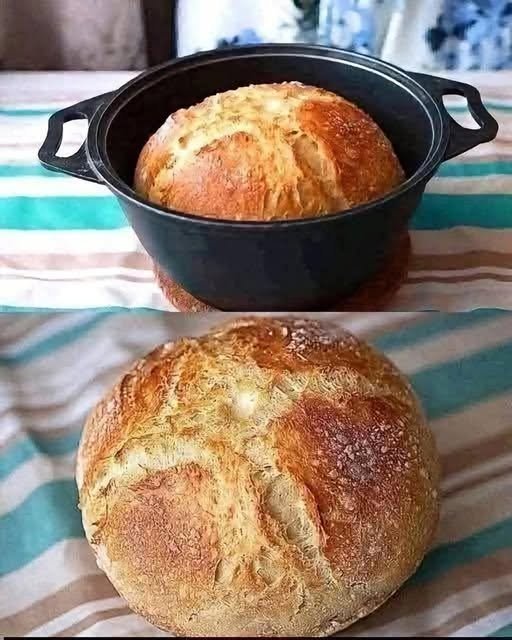
Dutch oven artisan bread provides complex carbohydrates with zero added fats or oil.
| Nutrient | Per Serving (1 slice / ~65g) | Daily Value (% DV) |
| Calories | 180 kcal | — |
| Total Fat | 0.5 g | 1% |
| Saturated Fat | 0 g | 0% |
| Sodium | 430 mg | 19% |
| Total Carbohydrates | 37 g | 13% |
| Dietary Fiber | 1.5 g | 5% |
| Sugars | 0.5 g | — |
| Protein | 6 g | 12% |
| Iron | 2.1 mg | 12% |
| Thiamin (Vitamin B1) | 0.3 mg | 25% |
High-Value Culinary Insights
1. The Role of Steam in Dutch Oven Baking
Commercial deck ovens inject high-pressure steam during early baking phases to gelatinize surface starches, allowing maximum oven spring before the outer crust sets. A heavy cast-iron Dutch oven traps moisture evaporating directly from the wet dough, simulating professional steam ovens to create a blistered, thin, and glossy crust.
2. High-Hydration Fermentation Science
The high hydration ratio (~75–80%) paired with a long 18-hour room-temperature fermentation eliminates manual kneading. Enzymes naturally present in wheat flour (proteases and amylases) break down starches into fermentable sugars while forming gluten networks slowly over time, delivering superior flavor complexity and irregular internal crumb structures.
3. Flour Selection & Protein Metrics
Using bread flour with a higher protein content (12%–14%) yields stronger gluten structures capable of supporting high hydration and long fermentation times, producing a chewy interior. All-purpose flour (10%–11.5% protein) provides a tenderer crumb with a softer crust profile.
Frequently Asked Questions
Can I bake artisan bread without parchment paper?
Yes. If parchment paper is unavailable, dust the bottom of the preheated Dutch oven with cornmeal or coarse wheat bran to prevent sticking. Avoid grease or oil, as high baking temperatures (450°F) cause oils to burn and smoke.
Why is my artisan bread dense inside?
A dense crumb usually indicates under-fermentation, old yeast, or slicing the bread while it is still hot. Cutting into warm bread allows internal steam to escape rapidly, compressing starches into a gummy, dense texture.
How do I store Dutch oven bread to keep the crust crispy?
Store sliced artisan bread in an unsealed paper bag or loosely wrapped in a clean cloth for up to 2 days at room temperature. Storing artisan bread in plastic bags or airtight containers traps residual moisture, softening the crunchy crust.