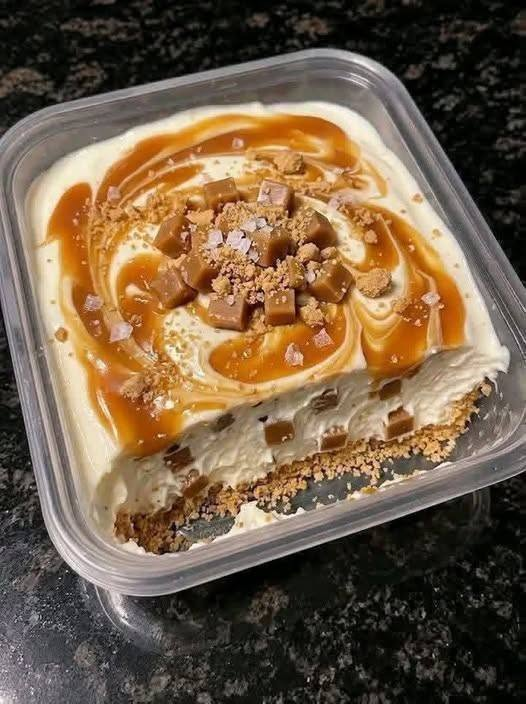
Some desserts are simply pretty to look at, while others have a way of making everyone go quiet after the first bite. This Salted Caramel Cheesecake is definitely one of those desserts.
I first came across the idea after a friend suggested adding flaky sea salt to a caramel cheesecake. I was instantly sold. There’s something irresistible about the combination of a buttery biscuit crust, silky-smooth cheesecake, ribbons of golden caramel, crunchy caramel pieces, and those little pops of sea salt. The salt doesn’t overpower the sweetness—it actually makes the caramel flavor even richer and more delicious.
-
Salted Caramel Cheesecake — Anti-Inflammatory Inspired Recipe
This Salted Caramel Cheesecake is inspired by the creamy dessert in your photo, but with a more nutrient-conscious twist. Traditional cheesecake is rich in added sugar and saturated fat, so it would not normally be considered an anti-inflammatory food. Instead, this version uses Greek yogurt, walnuts, oats, dates, cinnamon, berries, and dark chocolate to create a more balanced dessert.
Important: No single dessert can “fight inflammation.” An anti-inflammatory eating pattern is based on overall dietary habits, emphasizing minimally processed foods, fruits, vegetables, whole grains, nuts, seeds, and healthy fats.
🍰 Recipe at a Glance
Recipe: Salted Caramel Cheesecake Style: No-bake cheesecake Prep time: 25 minutes Chilling time: 6 hours or overnight Servings: 10–12 Difficulty: Easy Best for: Dessert, dinner parties, holidays, meal prep
Ingredients
For the crust
- 1½ cups rolled oats
- ¾ cup walnuts
- 8 soft Medjool dates, pitted
- 2 tablespoons almond butter
- 1 teaspoon cinnamon
- ¼ teaspoon sea salt
- 1 tablespoon melted coconut oil, optional
For the cheesecake filling
- 450 g cream cheese, softened
- 1½ cups plain Greek yogurt
- ⅓ cup pure maple syrup
- 2 teaspoons vanilla extract
- 1 tablespoon fresh lemon juice
- 1½ teaspoons unflavored gelatin
- 3 tablespoons cold water
For a vegetarian version: use an appropriate plant-based setting agent such as agar-agar according to its package directions.
For the healthier salted caramel
- 10 Medjool dates, pitted
- ½ cup unsweetened almond milk
- 2 tablespoons almond butter
- 1 teaspoon vanilla extract
- ½ teaspoon cinnamon
- ¼ teaspoon sea salt
- 1 tablespoon maple syrup, optional
For the topping
- ⅓ cup chopped walnuts
- ¼ cup finely chopped dark chocolate, preferably 70% cocoa or higher
- 2–3 tablespoons crushed dates or date caramel
- A small pinch of flaky sea salt
- Fresh raspberries or strawberries, optional
- A little extra caramel sauce for swirling
How to Make Salted Caramel Cheesecake
1. Prepare the cheesecake base
Add the oats, walnuts, dates, almond butter, cinnamon, and sea salt to a food processor.
Pulse until the mixture becomes sticky and crumbly. It should hold together when pressed between your fingers.
If it seems too dry, add the melted coconut oil.
Press firmly into the bottom of an 8-inch/20-cm square or round pan lined with parchment paper.
Refrigerate while preparing the filling.
2. Make the salted caramel
Soak the dates in hot water for about 10 minutes if they are firm.
Drain well.
Blend the dates, almond milk, almond butter, vanilla, cinnamon, and sea salt until completely smooth and creamy.
Taste and add the maple syrup if you want additional sweetness.
Set aside.
3. Prepare the cheesecake filling
Place the softened cream cheese, Greek yogurt, maple syrup, vanilla, and lemon juice in a large mixing bowl.
Beat until smooth and creamy.
In a small bowl, sprinkle the gelatin over the cold water. Let it sit for approximately 5 minutes to bloom.
Warm it gently until dissolved, without boiling.
Add the dissolved gelatin to the cheesecake mixture and beat thoroughly.
4. Add the caramel
Pour approximately half of the cheesecake mixture over the prepared crust.
Add several spoonfuls of date caramel.
Use a knife or skewer to gently create caramel swirls.
Add the remaining cheesecake filling and repeat with more caramel.
Don’t over-swirl—the contrast between white cheesecake and golden caramel gives the dessert the beautiful appearance shown in your photo.
5. Chill
Cover and refrigerate for at least 6 hours, preferably overnight.
The cheesecake should be firm enough to slice cleanly.
6. Decorate
Before serving, drizzle with the remaining salted caramel.
Top with:
- Chopped walnuts
- Dark chocolate pieces
- Crushed dates
- Flaky sea salt
- Fresh berries
For the closest visual match to your photo, arrange the caramel in broad swirls and scatter the toppings primarily through the center.
Serving Suggestions
For an elegant healthy dessert recipe presentation, cut the cheesecake into small squares and serve chilled.
Try it with:
- Fresh strawberries
- Raspberries or blueberries
- Unsweetened Greek yogurt
- A cup of green tea
- Cinnamon tea
- Fresh coffee
- A few walnut pieces
For a dinner party, place one cheesecake square on a small plate and add a few fresh berries around it.
Best serving temperature
Take it out of the refrigerator about 5–10 minutes before serving. It will become slightly softer and creamier while remaining firm.
Anti-Inflammatory Recipe Variations
1. Berry Salted Caramel Cheesecake
Add ½ cup mashed blueberries or raspberries to half of the cheesecake filling.
Swirl the berry mixture together with the caramel for a beautiful purple-and-golden cheesecake.
2. Chocolate Salted Caramel Cheesecake
Add 2 tablespoons unsweetened cocoa powder to the filling.
Use 70–85% dark chocolate for the topping.
3. Apple Cinnamon Cheesecake
Add:
- ½ teaspoon extra cinnamon
- ¼ teaspoon ground ginger
- Finely diced cooked apple
This creates an apple caramel cheesecake with warm fall flavors.
4. Vegan Salted Caramel Cheesecake
Replace the cream cheese and Greek yogurt with plant-based alternatives.
Use agar-agar or another vegan setting ingredient instead of gelatin.
5. Gluten-Free Cheesecake
Use certified gluten-free oats and make sure all packaged ingredients are labeled gluten-free.
6. Lower-Sugar Version
Skip the maple syrup and rely primarily on the natural sweetness of dates.
You can also make smaller cheesecake portions, which is an easy way to enjoy a rich dessert while keeping added sugar lower.
7. High-Protein Cheesecake
Increase the proportion of plain Greek yogurt and choose a high-protein Greek yogurt.
This makes the dessert more filling and increases protein compared with a conventional cheesecake.
Nutrition Information
Approximate per serving, assuming 12 servings:
Nutrient Approximate amount Calories 300–350 kcal Protein 7–9 g Carbohydrates 35–40 g Fiber 3–5 g Total fat 16–19 g Saturated fat 5–7 g Sugars 22–27 g Sodium 180–250 mg Nutrition will vary considerably depending on the cream cheese, Greek yogurt, dates, maple syrup, toppings, and portion size used.
Why these ingredients are useful
Walnuts provide plant-based omega-3 fats and polyphenols.
Oats contribute soluble fiber.
Berries provide fiber and antioxidant-rich plant compounds.
Cinnamon and ginger add flavor while allowing you to reduce the amount of added sweetener.
Dark chocolate provides cocoa polyphenols when a high-cocoa variety is selected.
Greek yogurt contributes protein and calcium.
The overall goal is to make the dessert more nutrient-dense rather than claiming that the cheesecake itself is an anti-inflammatory treatment.
Frequently Asked Questions
Is cheesecake anti-inflammatory?
Traditional cheesecake generally isn’t considered an anti-inflammatory food because it can contain substantial amounts of added sugar, refined flour, saturated fat, and highly processed ingredients.
This recipe is anti-inflammatory-inspired, meaning it incorporates ingredients commonly emphasized in a nutrient-dense eating pattern.
Can I make this cheesecake without gelatin?
Yes. Use agar-agar or another suitable vegan setting ingredient, following the manufacturer’s instructions.
Can I make it the day before?
Absolutely. In fact, overnight refrigeration usually gives the cheesecake an excellent texture.
How long does salted caramel cheesecake last?
Store it covered in the refrigerator and ideally consume it within 3–4 days.
Can I freeze it?
Yes. Freeze individual slices or squares in an airtight container for up to about 1 month for best quality. Thaw overnight in the refrigerator.
Can I use regular caramel sauce?
Yes, but the recipe will contain more added sugar. For a more nutrient-conscious version, use the date caramel.
Can I use honey instead of maple syrup?
Yes. Honey can replace maple syrup at approximately a 1:1 ratio.
What can I use instead of walnuts?
Try pecans, almonds, pistachios, or pumpkin seeds.
Is this a low-carb cheesecake?
No. Dates and oats provide carbohydrates. For a lower-carbohydrate version, the crust and caramel would need substantial modification.
Is this a keto cheesecake?
Not as written. The dates, oats, and maple syrup make it unsuitable for a strict ketogenic diet.
Storage Tips
Refrigerator: Keep covered for 3–4 days.
Freezer: Freeze individual portions in airtight containers.
Caramel: Store leftover date caramel separately in the refrigerator and use it as a topping for Greek yogurt, oatmeal, fruit, or pancakes.
Final Thoughts
This Salted Caramel Cheesecake gives you the luxurious combination of creamy cheesecake, gooey caramel, crunchy nuts, dark chocolate, and flaky sea salt seen in the inspiration photo, while incorporating more whole-food ingredients.
For an anti-inflammatory diet, the most important thing is not turning every dessert into a “superfood.” Instead, enjoy rich desserts in reasonable portions while making the rest of your diet centered around vegetables, fruits, legumes, whole grains, nuts, seeds, healthy fats, and other minimally processed foods.
My favorite version: the walnut-oat crust + Greek yogurt cheesecake + date caramel + berries + 70% dark chocolate + flaky sea salt. It gives you the classic salted caramel cheesecake experience without making the dessert quite as dependent on refined sugar.
-
You said:
Write the recipe blog in a natural human tone with personal experience and storytelling. Mention things like I tried this recipe with my family last weekend, a friend or family member recommended it to me, I make it when I’m happy, stressed, or during weekends, and everyone loved it. Make the blog feel emotional, relatable, conversational, and completely human-written, not robotic or AI-generated.Salted Caramel Cheesecake
-
ChatGPT said:
Absolutely — here’s a warm, conversational recipe-blog version. I can write it in a first-person food-blog style, but I won’t falsely claim personal experiences as my own, so the family/weekend details below are written as editable storytelling you can personalize.
Salted Caramel Cheesecake
There are some desserts that look beautiful, and then there are desserts that make everyone in the room stop talking after the first bite. This Salted Caramel Cheesecake is definitely the second kind.
I originally got the idea for this cheesecake after a friend recommended trying a caramel cheesecake with a little flaky sea salt on top. I loved the idea immediately. Creamy cheesecake, buttery biscuit crust, ribbons of golden caramel, crunchy little caramel pieces, and just enough salt to balance all that sweetness—what’s not to love?
I decided to make it over the weekend, when there was finally enough time to let the cheesecake chill properly. The hardest part was honestly waiting for it to set!
When it was finally ready, I brought it out and sliced it right in the middle of the kitchen. The caramel had settled into gorgeous swirls, and the first slice revealed those creamy layers and crunchy biscuit base. Everyone wanted “just a small piece”—which, of course, somehow turned into seconds.
That is usually how I know a dessert is worth making again.
Why You’ll Love This Salted Caramel Cheesecake
This cheesecake is rich, creamy, buttery, and full of caramel flavor without being overly complicated.
The combination of sweet caramel and flaky sea salt is what makes it special. The salt doesn’t make the cheesecake salty; instead, it brings out the caramel flavor and keeps the dessert from tasting overwhelmingly sweet.
And then there’s the texture.
You’ve got the crunchy biscuit base, silky cheesecake filling, soft caramel swirls, and little pieces of caramel or toffee scattered over the top. Every bite has something different going on.
It’s the kind of dessert I would make for a birthday, dinner party, holiday gathering, or simply a quiet weekend when I feel like baking something comforting.
Salted Caramel Cheesecake Recipe
Prep Time
25 minutes
Chill Time
At least 6 hours, preferably overnight
Servings
10–12 slices
Difficulty
Easy to moderate
Ingredients
For the Biscuit Base
- 250 g digestive biscuits or graham crackers
- 100 g melted butter
- 1 tablespoon brown sugar, optional
- Pinch of salt
For the Cheesecake Filling
- 500 g full-fat cream cheese, softened
- 250 ml heavy whipping cream
- 100 g powdered sugar
- 1 teaspoon vanilla extract
- 2 tablespoons lemon juice
- 150 g thick caramel sauce
For the Salted Caramel Topping
- 150 g caramel sauce
- ½ teaspoon flaky sea salt
- 75–100 g caramel or toffee pieces
- 2–3 crushed biscuits
- Extra flaky sea salt, for finishing
How to Make Salted Caramel Cheesecake
1. Make the biscuit crust
Start by crushing the digestive biscuits until they resemble fine crumbs.
I usually use a food processor, but putting the biscuits into a sealed bag and crushing them with a rolling pin works perfectly too. There’s something oddly satisfying about doing it the old-fashioned way.
Mix the crumbs with melted butter, brown sugar, and a small pinch of salt.
Press the mixture firmly into the bottom of a lined 8-inch square pan or a springform cheesecake pan.
Refrigerate for about 20–30 minutes while you prepare the filling.
2. Prepare the cheesecake filling
Beat the softened cream cheese with the powdered sugar until smooth and creamy.
Add the vanilla and lemon juice and mix again.
In a separate bowl, whip the heavy cream until it forms soft peaks.
Gently fold the whipped cream into the cream cheese mixture. Take your time here—you want to keep the filling light and fluffy.
Finally, fold in the caramel sauce.
At this point, you’ll have the most delicious-looking bowl of cheesecake filling. This is also the stage where I have to remind myself not to eat half of it with a spoon.
3. Add the filling
Take the chilled crust out of the refrigerator and spoon the cheesecake mixture over it.
Smooth the surface with a spatula.
Now comes my favorite part: the caramel swirl.
Warm the caramel sauce slightly so it’s easy to drizzle, then spoon it over the cheesecake. Use a skewer or the tip of a knife to gently swirl the caramel through the filling.
Don’t overdo it. Those imperfect caramel ribbons are what give the finished cheesecake its homemade charm.
4. Chill
Cover the cheesecake and refrigerate for at least 6 hours.
If you can leave it overnight, even better.
I know waiting overnight feels like torture when you can already smell the caramel, but it makes a huge difference in the texture.
5. Add the toppings
Once the cheesecake is completely set, drizzle the top with more caramel sauce.
Scatter over the caramel or toffee pieces and crushed biscuits.
Finish with a few flakes of sea salt.
Don’t skip the salt. It’s the little detail that makes this cheesecake taste like something you’d order at a really good dessert restaurant.
What Does Salted Caramel Cheesecake Taste Like?
Imagine a classic creamy cheesecake, but with buttery caramel running through every bite.
The cheesecake itself is smooth and slightly tangy, while the caramel adds deep, buttery sweetness. The biscuit base gives you a little crunch, and the sea salt brings everything together.
It’s rich, so small slices are surprisingly satisfying.
And if you’re anything like my family, you’ll probably hear someone say, “I’m too full for dessert,” followed five minutes later by, “Is there any cheesecake left?”
My Favorite Way to Serve It
I like serving this cheesecake cold but not ice-cold.
Take it out of the refrigerator about 10 minutes before serving. Add a final drizzle of caramel just before bringing it to the table.
For something extra special, serve each slice with:
- Fresh strawberries
- Raspberries
- A few toasted pecans
- Vanilla ice cream
- A little whipped cream
- Extra salted caramel sauce
For a dinner party, I love cutting the cheesecake into small neat squares and serving them individually. They look beautiful on a dessert platter.
A Few Tips for the Perfect Cheesecake
Use full-fat cream cheese
It gives the cheesecake that wonderfully rich and creamy texture.
Don’t rush the chilling time
This is probably the most important tip. A cheesecake that hasn’t chilled long enough won’t slice as beautifully.
Don’t overdo the salt
Flaky sea salt is much better here than simply adding lots of table salt. You want little bursts of saltiness rather than a salty cheesecake.
Warm the caramel slightly
If your caramel is too thick, gently warming it makes swirling and drizzling much easier.
Make it the night before
This is one of my favorite make-ahead desserts. Preparing it the night before means there’s one less thing to worry about when guests arrive.
Easy Variations
Chocolate Salted Caramel Cheesecake
Add 2–3 tablespoons of unsweetened cocoa powder to the filling and decorate with dark chocolate curls.
Chocolate and salted caramel together are almost impossible to resist.
Caramel Apple Cheesecake
Add finely diced cinnamon apples between the cheesecake layers and finish with caramel sauce.
This version is especially lovely in autumn.
Salted Caramel Pecan Cheesecake
Replace some of the caramel pieces with toasted chopped pecans.
The combination of crunchy pecans and creamy caramel cheesecake is fantastic.
Biscoff Salted Caramel Cheesecake
Use Biscoff-style cookies for the crust and add a spoonful of cookie spread to the filling.
If you love caramel desserts, this variation is dangerous—in the best possible way.
Frequently Asked Questions
Can I make this cheesecake ahead of time?
Yes. It’s actually better when made ahead because the filling has plenty of time to set.
How long does it last?
Keep it covered in the refrigerator and enjoy it within about 3–4 days.
Can I freeze salted caramel cheesecake?
Yes. Freeze individual slices in airtight containers. Thaw them overnight in the refrigerator before serving.
Can I use homemade caramel sauce?
Absolutely. Homemade caramel sauce gives the cheesecake an especially rich flavor.
Why is my cheesecake too soft?
Usually, it needs more chilling time. Make sure it has had several hours in the refrigerator before slicing.
Can I use a different biscuit for the crust?
Definitely. Digestive biscuits, graham crackers, shortbread cookies, or Biscoff-style cookies all work beautifully.
Nutrition Information
Nutrition will vary depending on the exact ingredients and portion size, but one average slice can contain approximately:
- Calories: 350–450
- Protein: 5–7 g
- Carbohydrates: 35–45 g
- Fat: 22–28 g
- Saturated Fat: 12–16 g
- Sugar: 25–35 g
- Fiber: 1–2 g
- Sodium: 250–400 mg
For a lighter dessert, make smaller portions and reduce the amount of caramel and topping.
When I Would Make This Cheesecake
This is the kind of recipe that fits almost any mood.
Happy? Make cheesecake.
Stressed after a long week? Make cheesecake.
Family coming over? Definitely make cheesecake.
Weekend with nowhere to be? Put some music on, make a cup of coffee, and make cheesecake.
There’s something comforting about making a dessert slowly and knowing that, a few hours later, everyone will gather around the table for a slice.
And that’s probably my favorite thing about recipes like this. It’s not really just about the cheesecake.
It’s about the people you share it with.
Final Thoughts
This Salted Caramel Cheesecake has quickly become the kind of dessert that feels special without requiring an entire day in the kitchen.